- For those of you who think the college entrance exams don't really give an accurate indicator of performance in college, there's a story out that suggests we don't really collect enough data at the institutional level about this topic: http://chronicle.com/article/Many-Colleges-Don-t-Put/236801/
- Do you get your news online? Seems like most of us do. Pew just released a report showing the effects -- a decline for newspaper circulation. http://www.journalism.org/2016/06/15/newspapers-fact-sheet/
- Courtesy of Jonathan, a story about Topeka's participation in a program about using data to make city improvement decisions http://cjonline.com/news/2016-06-13/city-topeka-selected-what-works-cities-initiative-open-data
Wednesday, 15 June 2016
In the news ...
A few items from across my feeds (and Jonathan's -- thanks!) that may be of interest:

Tuesday, 14 June 2016
OK, who has a cat?
What could be better than cats?
Cats + Data, right?
This article shares some data on the nocturnal travels of cats, courtesy of GPS:
http://www.boredpanda.com/gps-tracker-cat-movement-map-lithgow-central-tablelands-local-land-services/
If you need a study break, you simply must check it out right meow :)
Cats + Data, right?
This article shares some data on the nocturnal travels of cats, courtesy of GPS:
http://www.boredpanda.com/gps-tracker-cat-movement-map-lithgow-central-tablelands-local-land-services/
If you need a study break, you simply must check it out right meow :)
Monday, 13 June 2016
More 2015-16 school data!
Saw this article in The Democrat today:
http://www.tallahassee.com/story/news/2016/06/11/how-area-schools-stacked-up-state-tests/85761296/
A bunch of K-12 test scores were released on Friday. Leon County is doing well, but nonetheless some of the news is troubling:
http://www.tallahassee.com/story/news/2016/06/11/how-area-schools-stacked-up-state-tests/85761296/
A bunch of K-12 test scores were released on Friday. Leon County is doing well, but nonetheless some of the news is troubling:
On almost every test, Leon County students outperformed the state average. Significant jumps in how many students passed certain tests was evidenced at struggling schools in the district and in other counties.
But school-level results indicate that economically-disadvantaged and minority students did not fare as well as their peers, and not just in Leon County.
Sunday, 12 June 2016
Data manipulation via graphics?
This is a political story, but I'm not sharing it to be political. The basic deal is that Trump tweeted out graphs to prove that Obama has not been an effective president. Someone at the Washington Post took a closer look at these graphs to see if they were accurate and fairly presented. Remove candidate/leader names from your mind and take a look at this story:
What do you think?
Gun Violence in the US
I woke at 5 am today to a child in my bed with a (very) bloody nose. An hour later, that situation settled (bleeding stopped, shower taken to wash bloody hair, sheets changed), I climbed back in bed. Unable to easily fall back asleep, I grabbed my iPad to read. Then I saw the news alert. Instantly I knew this was one of those days when life would change again, when innocence was stolen yet again. Another mass shooting, so senseless, and relatively close to home. These are the times we live in, and I'm not yet immune to feeling a combination of sorrow and horror each time.
I hope you and your family and friends are all safe. I've checked in with my Orlando area friends, and thankfully they are all okay. But many others are not (and if you have Type O blood you might want to help out by donating).
I'm not writing this to engage in a conversation or debate about gun rights, but needless to say this has been one of the topics blowing up my Facebook feed today. One friend shared this NPR piece from last December, which discusses the lack of a gun violence database at a time when gun violence seems to be increasing (just the stats on Chicago in a give weekend over summer are absolutely alarming):
http://www.npr.org/2015/12/09/459056018/the-u-s-has-a-mass-shooting-epidemic-but-no-federal-database-on-gun-violence
I hope you and your family and friends are all safe. I've checked in with my Orlando area friends, and thankfully they are all okay. But many others are not (and if you have Type O blood you might want to help out by donating).
I'm not writing this to engage in a conversation or debate about gun rights, but needless to say this has been one of the topics blowing up my Facebook feed today. One friend shared this NPR piece from last December, which discusses the lack of a gun violence database at a time when gun violence seems to be increasing (just the stats on Chicago in a give weekend over summer are absolutely alarming):
http://www.npr.org/2015/12/09/459056018/the-u-s-has-a-mass-shooting-epidemic-but-no-federal-database-on-gun-violence
Mark Follman, a journalist featured in this NPR piece who noted the lack of a central database, set out to gather the information himself. He writes for Mother Jones and you can find some of his database work here:
I know the date in the URL is 2012, but it's been kept up to date. A note at the top says that they're updating it with Orlando data.
Going on a data diet?
The National Science Foundation has an annual report that shares data on science and engineering. It's called Science and Engineering Indicators.
As I learned in an article in Science, the size of this report has steadily grown since its inception in 1972:

But now there's talk of slimming back down -- although not everyone thinks that's a good idea. Read more here?
http://www.sciencemag.org/news/2016/05/could-shrinking-nsf-s-beloved-indicators-be-boon-researchers
What do you think? Is it a bad idea to go on a data diet?
As I learned in an article in Science, the size of this report has steadily grown since its inception in 1972:
But now there's talk of slimming back down -- although not everyone thinks that's a good idea. Read more here?
http://www.sciencemag.org/news/2016/05/could-shrinking-nsf-s-beloved-indicators-be-boon-researchers
What do you think? Is it a bad idea to go on a data diet?
Thursday, 9 June 2016
About our Children
I saw in the newspaper today that Whole Child Leon had released its 2016 report on the children of Leon County. You can find it here:
http://online.anyflip.com/ylil/kims/#p=1
Lots of charts and graphs showing the data, and there are some disturbing trend in recent years, like a big jump in 2009 of the % of children living in poverty (it has since stayed stable at that higher level). We have some huge issues including infant mortality and school readiness, and the problems occur at a higher rate among the low-income population.
http://online.anyflip.com/ylil/kims/#p=1
Lots of charts and graphs showing the data, and there are some disturbing trend in recent years, like a big jump in 2009 of the % of children living in poverty (it has since stayed stable at that higher level). We have some huge issues including infant mortality and school readiness, and the problems occur at a higher rate among the low-income population.
Tuesday, 7 June 2016
Name data
My kindergarten class had 5 Jennifers in it. How about yours?
Names come and go in their popularity. Here's a fun article with some data on names. It discusses how one might predict age based on name:
http://fivethirtyeight.com/features/how-to-tell-someones-age-when-all-you-know-is-her-name/
What do you think? Is Gertrude older than Sophie? Is Clarence older than Kaden?
Names come and go in their popularity. Here's a fun article with some data on names. It discusses how one might predict age based on name:
http://fivethirtyeight.com/features/how-to-tell-someones-age-when-all-you-know-is-her-name/
What do you think? Is Gertrude older than Sophie? Is Clarence older than Kaden?
Saturday, 4 June 2016
Basketball Analytics
Thanks to Jonathan for this link ...
So the Golden State Warriors are HOT! And part of the reason is their use of analytics (OK, I shouldn't be causal here, but I bet they see a link).
Read this story to learn about how the players are wearing monitors (think super souped-up fitbits) that collect data on their performance:
http://www.cnet.com/au/news/golden-state-warriors-use-their-tech-advantage/
So the Golden State Warriors are HOT! And part of the reason is their use of analytics (OK, I shouldn't be causal here, but I bet they see a link).
Read this story to learn about how the players are wearing monitors (think super souped-up fitbits) that collect data on their performance:
http://www.cnet.com/au/news/golden-state-warriors-use-their-tech-advantage/
Thursday, 2 June 2016
An iPad ... leaving a trail of data in its wake ...
Cute and happy story from the NYTimes about an iPad gone missing, tracked, and returned.
Enjoy! http://www.nytimes.com/2016/05/02/technology/an-ipad-misplaced-at-the-airport-takes-its-own-vacation.html
Enjoy! http://www.nytimes.com/2016/05/02/technology/an-ipad-misplaced-at-the-airport-takes-its-own-vacation.html
Tuesday, 31 May 2016
Facebook's Manipulation of Users' News Feed
Have you been seeing a lot of joyful stories of your friends on your Facebook news feed recently? Or, are you tired of reading upsetting news on Facebook which causes you to be sad throughout the day? Maybe the reason is that you have been selected as a participant of Facebook's news feed manipulation study. Yaay!? Check this article to see how Facebook manipulated its users' news feed to create emotional response. Well, although it is interesting to see the results, should Facebook manipulate what we see on our news feed at all? What does this study tell about Facebook or other Internet giants being able to do to people with the data they have? I wonder what you all think about it.
Sunday, 29 May 2016
Data: Who are these "online students"?
Coming across my feed multiple times in the last few days ...
Mike Caulfield comments on who online students are, in response to a Blackboard report.
I recommend reading the Bb report. Here's a snip from the beginning:
Most students who enroll in an online class recognize and express that they are agreeing to a lesser experience.
Yikes! That doesn't make me feel all that good as an online instructor. But when situated within other data points (namely about who these online learners are: campus student taking extra courses online), it makes sense. I don't think it is a lesser experience (or doesn't have to be; different, but not lesser), but I can see how some people would enter and/or exit an online class holding that belief.
And Phil Hill provides additional commentary:
What do you think?
Tuesday, 24 May 2016
The ethics of (public?) data
On dating site OKCupid, a lot of data is visible to registered users. This profile data is part of the service that OKCupid provides, allowing individuals to learn about and communicate with other site users. Users might assume that what happens on the web site stays on the web site (kind of like Vegas, right?) ... but is that necessarily the case? Nope. Check out this article from Christian Science Monitor about the reaction to Danish students scraping the site and releasing the "public" data as data set on a shared data site. Oh, and they took no steps to anonymize it because it was already "public."
http://www.csmonitor.com/Technology/2016/0514/Privacy-online-OKCupid-study-raises-new-questions-about-public-data
What do you think about this case ... as an individual who signs up for and uses various online services? As a professional who needs to access and analyze data?
http://www.csmonitor.com/Technology/2016/0514/Privacy-online-OKCupid-study-raises-new-questions-about-public-data
What do you think about this case ... as an individual who signs up for and uses various online services? As a professional who needs to access and analyze data?
Monday, 23 May 2016
Developing Data Story: Egypt Air Crash
The tragic news last week of the Egypt Air plane crash, followed by the search for both the plane and a cause of the crash, has brought with it a data story.
So, what are some of the data that we have?
So, what are some of the data that we have?
Reading scores are in!
Typically the state release of K-12 test scores coincides with this class :)
At the end of last week, reading scores came out. Here's a story from the Tallahassee Democrat about the scores, with a local focus:
So, now what do we do with the data? The focus here is on kids getting a 3 (on level) or above, and the numbers are % of kids in a school scoring 3+.
I'm going to consider all of this as a parent.
Data and the credit industry
Jonathan kindly shared this article titled How Data is Changing Credit.
The article provides a brief but interesting commentary on how data are used to assess creditworthiness and can now provide assessments on the lending risk to people who have a relatively low amount of data available about their creditworthiness (and who, in the past, would have been declined a loan on those grounds -- even if really they weren't a bad risk).
What do you think?
The article provides a brief but interesting commentary on how data are used to assess creditworthiness and can now provide assessments on the lending risk to people who have a relatively low amount of data available about their creditworthiness (and who, in the past, would have been declined a loan on those grounds -- even if really they weren't a bad risk).
What do you think?
Wednesday, 18 May 2016
"Failure Factories" and data visualization
The Tampa Bay Times wrote a series called "Failure Factories: How Pinellas County is failing its black students." In addition to being an important and compelling read about our schools that includes a lot of data, they have provided a prologue that tells the basic story via data visualization. You simply must check this out:
Link to prologue: http://www.tampabay.com/projects/2015/investigations/pinellas-failure-factories/chart-failing-black-students
Link to whole series: http://www.tampabay.com/projects/2015/investigations/pinellas-failure-factories/
What do you think? Does the visualization enhance the powerful nature of the story? Why or why not?
Monday, 16 May 2016
Faculty don't want to be evaluated via analytics
Interesting article that just came out about analytics and faculty at Rutgers University:
https://www.insidehighered.com/news/2016/05/11/rutgers-graduate-school-faculty-takes-stand-against-academic-analytics
The basic gist: The university contracted a data mining company to examine faculty productivity (publications, etc.) and benchmark against faculty elsewhere. The faculty do not want to be evaluated in this way, and have noted that there are errors in the system.
The university is downplaying a bit, especially when the question of cost is raised:
https://www.insidehighered.com/news/2016/05/11/rutgers-graduate-school-faculty-takes-stand-against-academic-analytics
The basic gist: The university contracted a data mining company to examine faculty productivity (publications, etc.) and benchmark against faculty elsewhere. The faculty do not want to be evaluated in this way, and have noted that there are errors in the system.
The university is downplaying a bit, especially when the question of cost is raised:
Addressing concerns about the cost of the four-year contract, the chancellor said it’s annually about the equivalent of hiring a midlevel analyst. But one person “could not possibly provide the information that we get from Academic Analytics, with data from hundreds of universities and thousands of faculty members.”What do you think about this situation? Try to think about it from both perspectives.
Saturday, 14 May 2016
Video on Big Data
Just in case you are interested, a short video named "Big data... what is means to you"
So, I've been walking ... have data to prove it
I spent the last week in Istanbul. Incredible experience. Tiring, too. Why? Well, first I was burning the candle at both ends so I could work and play tourist (which meant little sleep). And also I was walking everywhere. And I mean EVERYWHERE.
Here are some of my data:


Here are some of my data:

This is from the Health app on my phone.
It really does tell the story of my week.
May 8 - flying, walking at home and airport
May 9 - flying, arrive in Istanbul, walk to dinner
May 10 - sleep in, solo touring in local area plus acclimating
May 11/12 - power touring with a local
May 13 - work all morning, light touring in afternoon
May 14 - incomplete data
And here's fitbit data from a single day:

I've actually cross-checked Fitbit and Health, and found that they report similar findings. That suggests they're effectively calibrated with each other. They weren't exact matches on steps, but that would be a bit much to expect. Plus there were probably some steps in my hotel room without the phone in hand. There was one error in the Fitbit data: When I switched the time zone on Fb it got confused and so my Tuesday data shows as Tuesday and then on Wed it recorded Tues + Wed together. I was aware of this, couldn't fix it in the app, but I made the mental calculation to get the data.
And now the bigger question: Who cares? It's data, but is it important? I was actually glad to have the data, and to be able to see the distances I was walking. These distances are meaningful to me since I run half-marathons, but had no way of telling how much walking I was doing. Also, I've been thinking about how I need to up my game when I get home (not enough running -- or walking -- this spring) and the data is motivating me to keep going.
Tuesday, 10 May 2016
what size data do we really want (need?) in education
Today the Washington Post published an article discussing the issue of data use in education. Ashley and I both read it independently, and I'm guessing a few others of you may have seen it, too. It foreshadows a bit of our Week 2 topical focus.
The article recaps the obsession we've had with big data for the last several years, and suggests that small data, however, is the new "plastics." (OK, that was an old movie reference, glory to whoever in the class recognizes it.)
Read the story here:
https://www.washingtonpost.com/news/answer-sheet/wp/2016/05/09/big-data-was-supposed-to-fix-education-it-didnt-its-time-for-small-data/
Personally, I tend to agree. We've got it all wrong. If we worried less about benchmarking to global trends and more about looking at what's happening nearby (focus on local and formative assessment, not on those big high stakes tests), we could solve our local problems and be on the path to actual learning.
What do you think?
(And during Week 6 we're reading an article about small data -- so yes, we're going there)
The article recaps the obsession we've had with big data for the last several years, and suggests that small data, however, is the new "plastics." (OK, that was an old movie reference, glory to whoever in the class recognizes it.)
Read the story here:
https://www.washingtonpost.com/news/answer-sheet/wp/2016/05/09/big-data-was-supposed-to-fix-education-it-didnt-its-time-for-small-data/
Personally, I tend to agree. We've got it all wrong. If we worried less about benchmarking to global trends and more about looking at what's happening nearby (focus on local and formative assessment, not on those big high stakes tests), we could solve our local problems and be on the path to actual learning.
What do you think?
(And during Week 6 we're reading an article about small data -- so yes, we're going there)
Global temperature change: A data story
Came across this on Facebook today (my friends tend to be data visualization geeks, too).
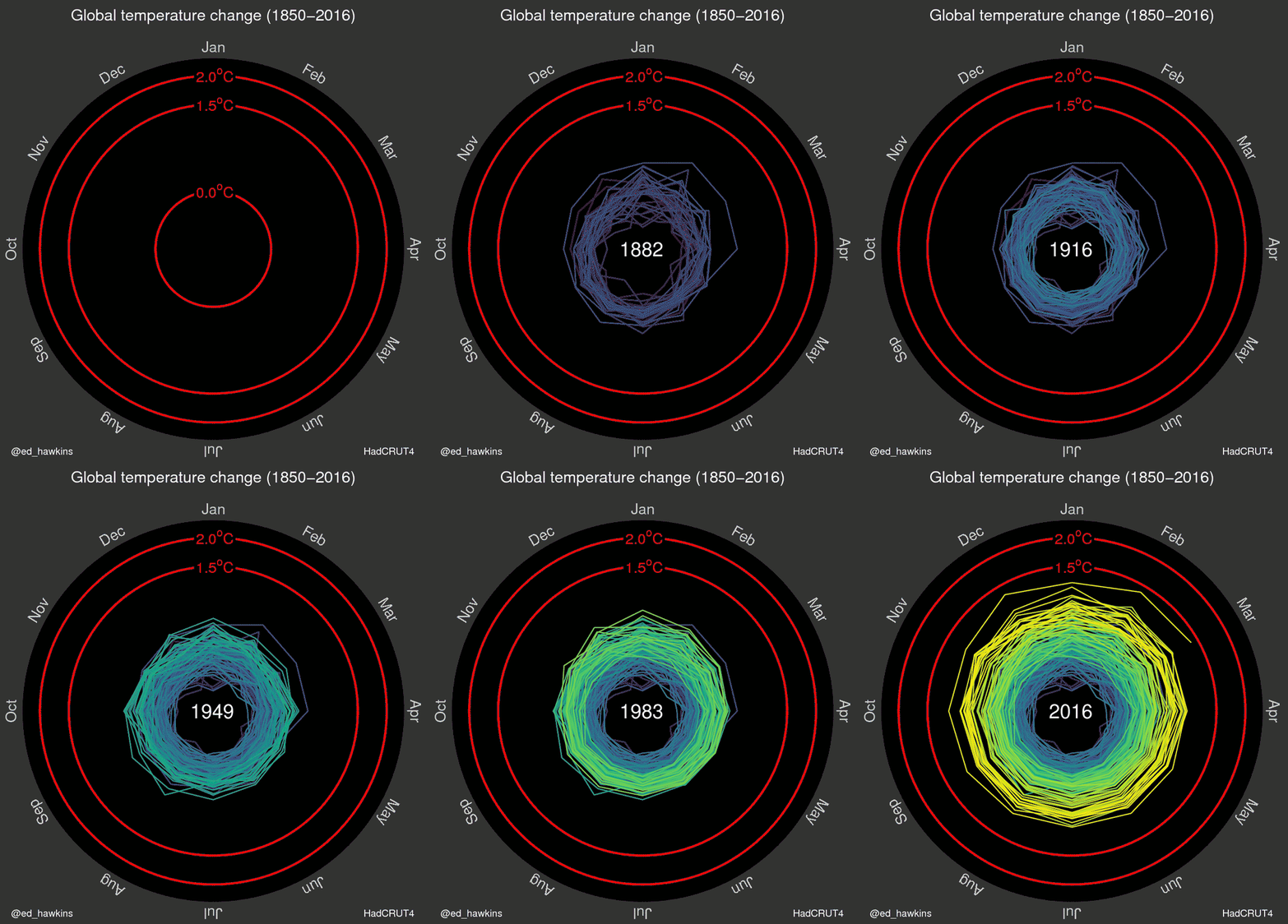
To read more about it, go here.
To read more about it, go here.
Monday, 9 May 2016
Greetings from Istanbul ... and analytics of my journey
I've arrived in Istanbul! For my next magic trip I will collapse and perhaps sleep as long as 12 hours (or not). My fitbit will tell that tale tomorrow morning, but in the meantime I'll share the analytics of my day courtesy of the health app on my iPhone. It was on my person continuously since about 5 pm Florida time yesterday, when I arrived at the airport. The data display starts at midnight in Istanbul, which was 5 pm Tallahassee.

Essentially ... walking around TLH, flying, walking around ATL, flying (various bathroom trips but mostly no bar), a lot of walking around CDG, 3 hr flight to IST (no bars), then walking around airport at IST (big bar at 5 pm), transit to hotel, walking to dinner. Yeah, I see my day there.
Pretty much no stairs.
I've got higher goals for tomorrow ... but more about that later.
Do you have an iPhone? If so, see where your stats are at.

Essentially ... walking around TLH, flying, walking around ATL, flying (various bathroom trips but mostly no bar), a lot of walking around CDG, 3 hr flight to IST (no bars), then walking around airport at IST (big bar at 5 pm), transit to hotel, walking to dinner. Yeah, I see my day there.
Pretty much no stairs.
I've got higher goals for tomorrow ... but more about that later.
Do you have an iPhone? If so, see where your stats are at.
Friday, 6 May 2016
Welcome to the Course!
Welcome to the course!
We'll be using this blog for sharing course-related news and other items of interest -- things that haven't been explicitly woven into the syllabus as required readings and videos but that nonetheless enhance the course experience.
Expect new posts a few times per week, and feel free to suggest items by sending an email to Vanessa or Yasin.
As a cool side benefit, the more you click around and interact on this blog, the more data you generate. We can play with that data later in the course.
We'll be using this blog for sharing course-related news and other items of interest -- things that haven't been explicitly woven into the syllabus as required readings and videos but that nonetheless enhance the course experience.
Expect new posts a few times per week, and feel free to suggest items by sending an email to Vanessa or Yasin.
As a cool side benefit, the more you click around and interact on this blog, the more data you generate. We can play with that data later in the course.
Subscribe to:
Posts (Atom)